what is a digicam?
People ask this all the time and the question never resolves. Is it CCD only? Anything before 2008? Is there a megapixel ceiling? The question survives intact, ready to be asked again.
I've come to think it never resolves because it's asked about the wrong thing. Every answer on offer is an answer about hardware — sensors, years, brands. But the thing we actually fell in love with was never the hardware. It was what came out.
A digital photo is a file before it's a picture. I don't mean that as a technicality. Before anyone sees a picture, light has to be lost into a sensor that can only hold so much; color has to be lost into numbers; detail has to be translated. Losing isn't a defect of digital photography — it's what makes it special. Every digital image that has ever existed began by giving something up.
Most of photography's energy, and nearly all of its marketing, goes into hiding this. Cleaner, sharper, quieter, more. Especially now, in the age of AI, object removal and noise reduction tools. The loss is treated as an embarrassment to be engineered away — and the strange result is that the most advanced cameras now make images with the least evidence that a machine was ever involved. Surfaces so smooth there's nothing left of the making.
Painters spent a century going the other way. They stopped hiding the brushstroke and let it sit on the surface; later some of them burned the canvas, slashed it, built pictures out of tar and sacking. We learned to read those marks as the most honest thing in the work — the place where the making shows. But those were always the marks of a hand. However scarred the surface, a person put every mark there on purpose.
What happens in my own photographs is different, and it's the one small idea this whole piece exists to offer: the marks in them are not mine. The noise that blooms across a dark sky, the color that fringes a hard edge, the gradient that breaks into bands — the sensor made those, in its own involuntary handwriting, at the limit of what it could do. The limit is a place I take it on purpose. But once it's there, the marks are entirely its own: I can ask for them; I can't draw them. They aren't my gesture. They're the machine's answer.
There's a photograph I keep coming back to. Two figures at the edge of the water, boards under their arms, their reflections hanging beneath them in the wet sand. Surf coming in on a long diagonal. Far down the shore, a pier and a line of towers dissolving into haze. Hardly any light left — or arriving; it doesn't much matter.
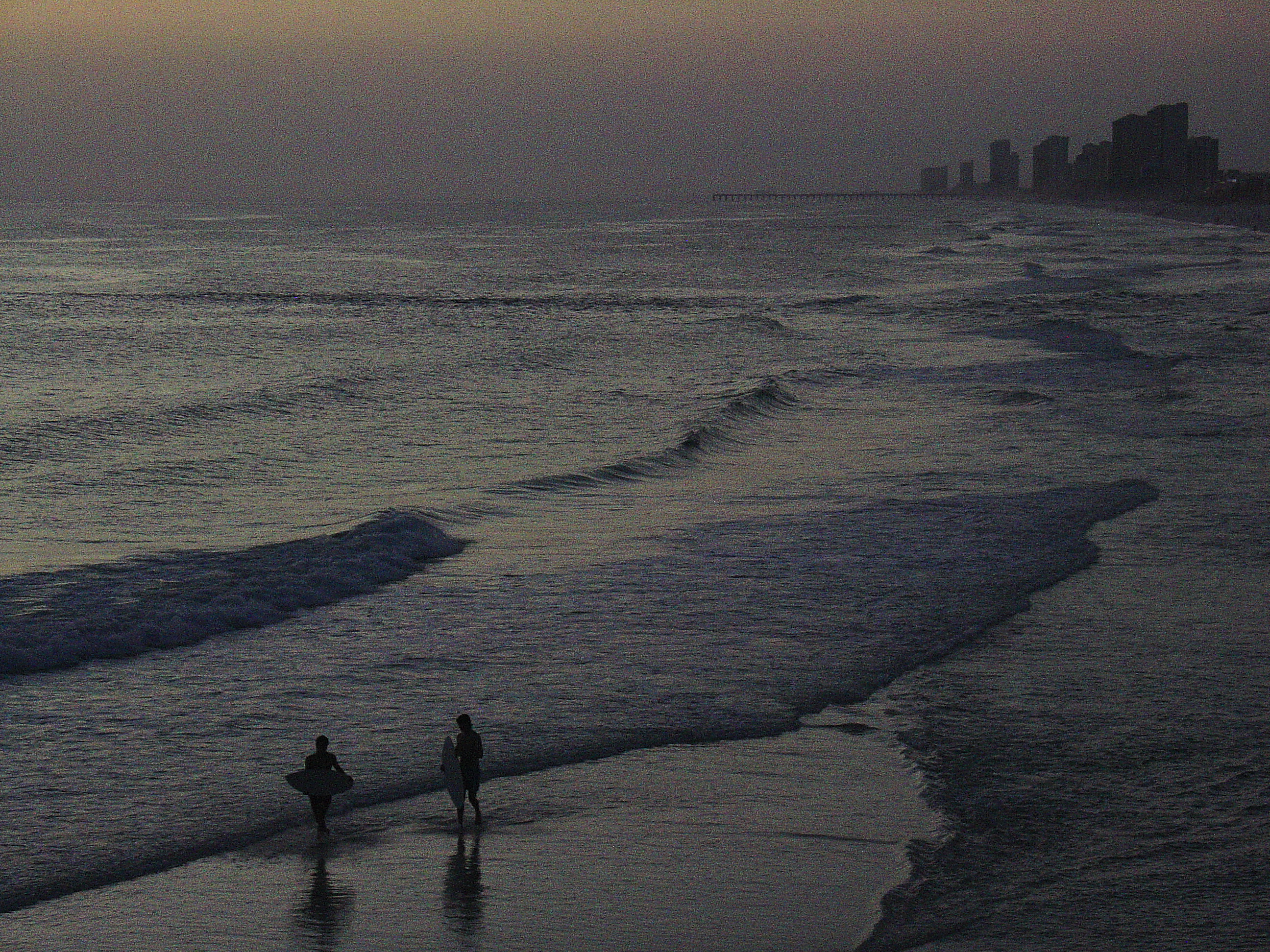
Described that way, it's a postcard. You've seen it a thousand times; so have I. If I had played it safe — dropped the ISO, let the sky come out a smooth wash of color and the towers stay crisp — it would be nothing. A picture you scroll past.
What makes it is the noise, and the noise is not an accident. I set the ISO higher than the scene needed, deliberately, because I wanted to hear what this sensor would do when asked for more than it had. It reached, and the reaching is visible everywhere. The sky isn't a gradient; it's a field of trembling grain. The air itself looks granular, almost humid. The towers have gone soft, like something remembered instead of recorded. The noise isn't sitting on top of the scene — it is the scene, the evening's actual texture, the third presence on that beach. Smooth it away and the picture dies back into the postcard.
I didn't draw any of those marks — I couldn't have. What I did was set the conditions and ask. Honestly, that's most of the practice: asking a machine a question it can only answer in its own voice.
Some things I've noticed, and some things you might try
What I've noticed: an image that loses detail often gains feeling. A noisy sky reads as weather. A soft edge reads as memory. We say these pictures look wrong, but mostly they look the way remembering feels.
You might try shooting at the ISO the manual warns you about, in light the camera was never meant for — not to rescue a dark scene, but to find out what that particular sensor does when you ask too much of it.
What I've noticed: the marks only mean something if the sensor actually made them. I'll gladly carry a camera into conditions that force it to struggle — that part is mine to arrange. But afterward I let the file stand. Anything added later is my gesture, not the machine's, and it's the machine I want to hear.
You might try treating each camera as its own experiment. No two sensors strain the same way: one blooms, one bands, one turns shadows into colored weather. The work isn't collecting them — it's playing them, the way you'd learn what each instrument can do that no other can.
What I've noticed: this isn't about old cameras, and it isn't longing for some better past. Any sensor pushed past its comfort will speak — including the one in your phone, though the phone works very hard to talk over it. Older digital cameras simply let the voice through. That's the only sense in which the tool matters: not which sensor, but whether you can still hear it. And the aim isn't pictures that look like the past. It's pictures that couldn't be made any other way — which is the opposite of nostalgia. It's new material.
None of this has a name. I've thought about giving it one and stopped every time — naming a thing is a way of closing it, and I'd rather leave it open. If these ideas turn out to be useful to anyone besides me, a name can come from wherever the use happens.
So: what is a digicam? I no longer think it's a kind of camera at all. I think it might be any camera operating close enough to its limits that you can hear it — which would mean the question was never about hardware, and was always about listening.
Which leaves the question I actually want to ask. Every sensor has a voice, and almost no one has ever asked to hear it — we've only ever asked cameras to disappear into clean pictures. Yours will answer differently than mine. That's the whole experiment.
What might your camera make, if you asked it for more than it was built to give?